
The historic venues of the Ray Dolby Centre and the Cambridge Union became the global epicenter for digitalization and sustainable infrastructure from July 22–24, 2026. The co-located celebration of SASBE 2026 (10th International Smart and Sustainable Built Environment Conference) and BDTSC 2026 (2nd Building Digital Twin Scientific Conference) brought together the brightest minds from academia, public management, and the technology industry.
Eduard Loscos Opened the Building Digital Twin Scientific Block (BDTSC 2026)
The opening of the advanced data and technology block was formally presided over by Eduard Loscos, who played a leading role as the President of the Building Digital Twin Association (BDTA) and R&D Manager at IDP Bureau Veritas.
In his specific welcome speech for the BDTSC 2026 sessions, Loscos highlighted the decisive step currently facing the AECOO sector (Architecture, Engineering, Construction, Operations, and Owners). He emphasized that Digital Twins are no longer just simple three-dimensional geometric models. Today, they are cementing their role as ethical management ecosystems and semantic ontologies capable of monitoring material lifecycles in real time and decarbonizing Europe’s building stock.
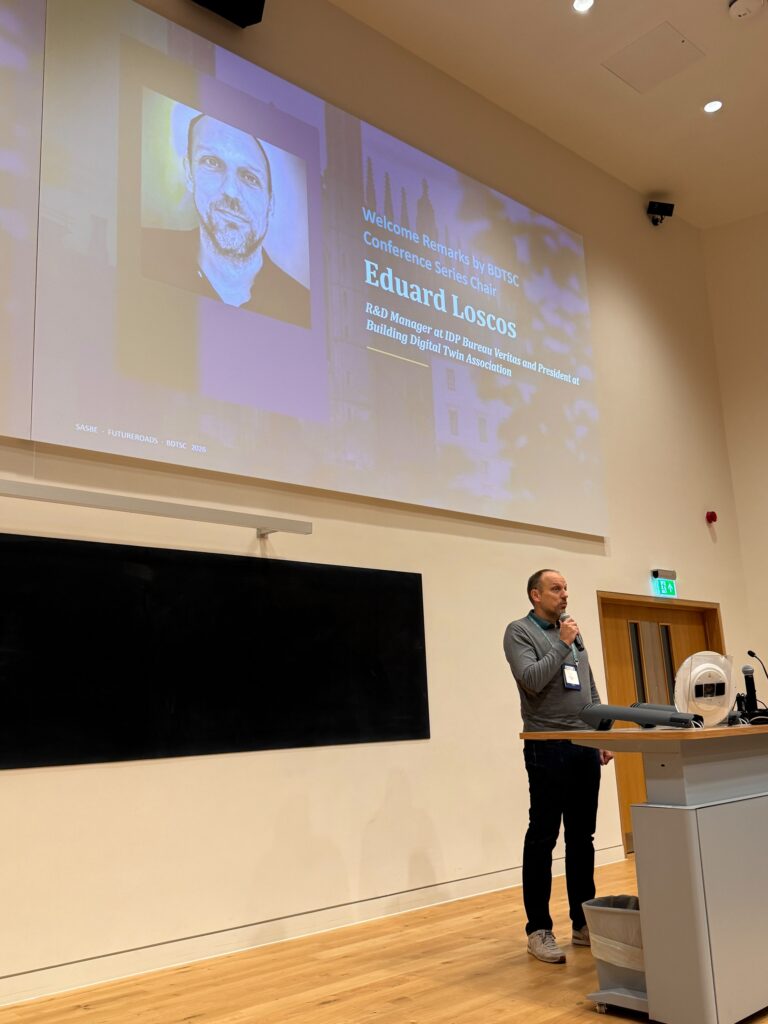
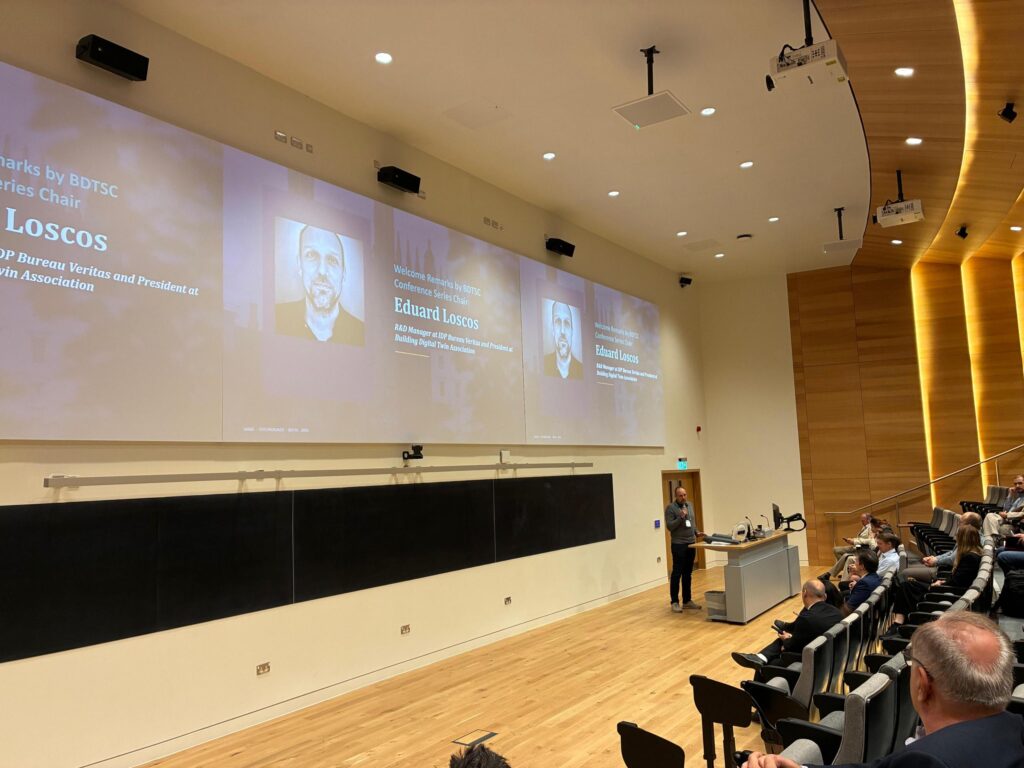
Eduard Loscos delivering the opening welcome speech at the Cambridge Union rostrum.
High-Level Participation and Scientific Output
The organizing committee and scientific reviewers of the joint event coordinated a rigorous peer-review process that structured the conference days around key milestones:
- Inflow of Papers: Dozens of rigorously selected research articles and scientific papers were presented and discussed. These focused heavily on interoperability, predictive data analytics, and Artificial Intelligence applied to resilient cities.
- Who Participated?: The forum gathered a highly technical profile composed of established researchers, top-tier postgraduate students, and software engineers. Key highlights included contributions from European Union-funded consortia, institutional delegates from the International Council for Research and Innovation in Building and Construction (CIB), and innovation leaders from infrastructure technology corporations.
Key Outcomes of the Cambridge Event
This edition’s parallel sessions and roundtables delivered conclusions with an immediate impact on the industry:
- Blending Green and Digital Criteria: A unanimous consensus was reached regarding the critical need to standardize Digital Product Passports for materials using Digital Twins.
- FUTUREROADS Outcomes: The presentation of final conclusions regarding the autonomous monitoring of roads and linear smart infrastructure.
Event Ficha & Metrics
| Concept | Event Detail 2026 |
|---|---|
| Central Venue | University of Cambridge, United Kingdom (Ray Dolby Centre) |
| BDTSC Opening | Eduard Loscos (President of BDTA / R&D Manager at IDP Bureau Veritas) |
| Allied Entities | CIB W116, Building Digital Twin Association (BDTA), and the University of Cambridge |
| Next Stop (2027) | Delft, Netherlands (BDTSC3 + SASBE + DFBI) |
Heading to Delft 2027: A Triple Alliance for the Next Edition
The crowning achievement of this year’s meeting was the official announcement of the host city for the next cycle. The city of Delft (Netherlands) will host the third edition (BDTSC3) next year.
For this upcoming event, the scientific ecosystem will expand even further. The congress will maintain its close collaboration with SASBE and strategically integrate the committee of the DFBI (Digital Future of Built Infrastructure), creating an unprecedented multidisciplinary forum in Dutch territory.
Full articles and the definitive repository of accepted papers from Cambridge will become progressively available on the SASBE 2026 portal and through BDTA official channels.